
Watch how this happened and our response.
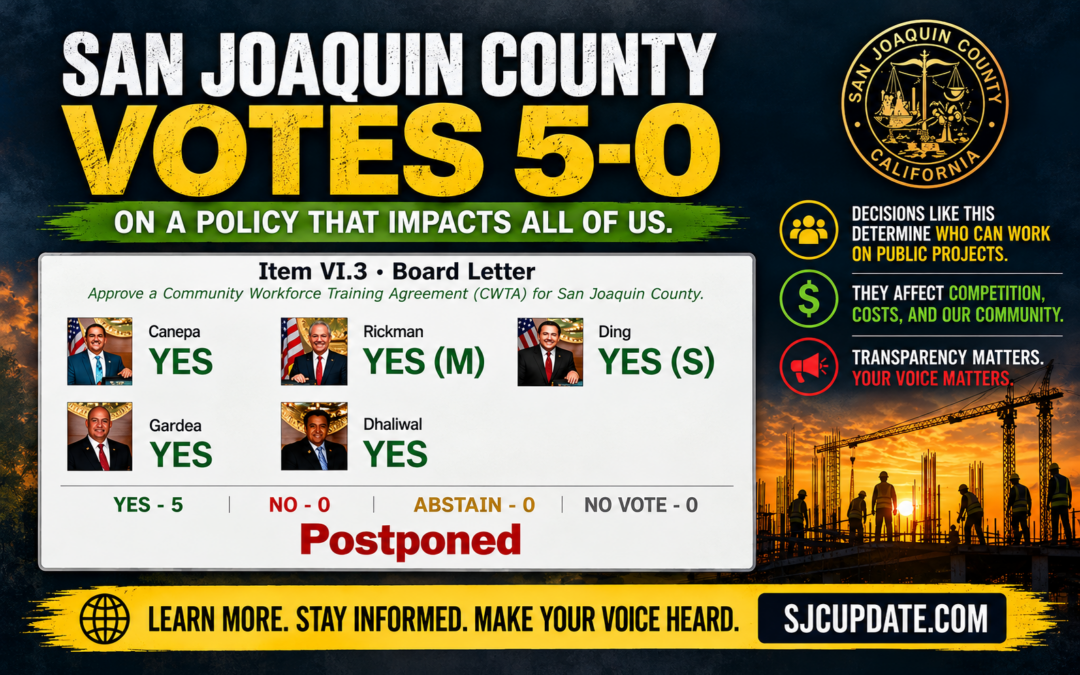
*Item VI.3 — Proposed Community Workforce Training Agreement (CWTA) for San Joaquin County
*Supervisor Paul Canepa: YES
*Supervisor Robert Rickman (Motion): YES — raised concerns about process
*Supervisor Steven Ding (Second): YES — raised concerns about process
*Supervisor Gareth Gardea: YES
*Supervisor Sonny Dhaliwal (Chair): YES
Final: 5-0 to Postpone — No Return Date Set
The Board Voted 5-0 to Postpone. Here's What That Means — And What Happens Next.
On Tuesday, April 28, 2026, the San Joaquin County Board of Supervisors voted unanimously — 5 to 0 — to postpone Item VI.3: a proposed Community Workforce Training Agreement (CWTA) for San Joaquin County. No date has been set for it to return.
What Was On the Table
A Community Workforce Training Agreement — like a Project Labor Agreement — is a policy that sets the terms for how public construction projects are awarded. It would determine:
- Which contractors are eligible to bid on county-funded projects
- What labor requirements those contractors must meet
- Who gets to work on projects paid for by San Joaquin County taxpayers
In practice, these agreements typically require contractors to operate under union labor terms — which effectively excludes the majority of qualified local workers and businesses who are non-union. In San Joaquin County, that’s approximately 85% of the construction workforce.
When competition is reduced, costs go up. Independent research consistently shows that agreements like this increase public project costs — costs that come directly out of the county budget and ultimately out of taxpayers’ pockets.
On the surface, a postponement can look like a procedural footnote. It isn’t.
Here’s what happened, what was said, and why this vote — and what comes next — matters to every worker, contractor, and taxpayer in this county.
How It Was Brought Forward — And Why That Matters
The vote was 5-0. But two of those five supervisors made a point of saying the process was wrong.
Supervisors Rickman and Ding both raised concerns about how this item was introduced — specifically that Board Chair Dhaliwal brought it forward via email on a Friday afternoon, giving fellow supervisors, local businesses, workers, and the public minimal time to review, respond, or weigh in on a decision of this significance.
This was not a small thing. And the community deserved more notice than a 4:00 PM, Friday email.
Their willingness to say that on the record is significant. It signals that the process used to push this agreement through is itself a legitimate concern, separate from the policy debate.
Decisions that affect thousands of workers and millions in taxpayer spending deserve transparency. They deserve public input. And they deserve more than a weekend’s notice.
That’s not a political position. That’s a basic standard of accountability.
In Their Own Words — What Supervisors Said at the Meeting
At the April 28 board meeting, two supervisors took the unusual step of publicly criticizing how the item was brought forward.Their statements are part of the official public record.
Coalition Issues Legal Warning Before the Vote
Before the April 28 vote, Eric Christen — Executive Director of the Coalition for Fair Employment in Construction (CFEC) and a 25-year veteran of PLA battles across California — sent a formal written warning to all five San Joaquin County Supervisors.
The email, sent April 24, 2026 and CC’d to county staff and local media, cited serious concerns about the meeting agenda — including broken document links that prevented the public from reviewing key materials before the vote, and what Christen described as a confusing and contradictory agenda structure designed to obscure public business.
The warning was direct:
Please REMOVE these two items (Item VI.3 and Item VI.6) from the April 28 meeting agenda. Respect the public.
Be forewarned that we will immediately file a lawsuit under the Ralph M. Brown Act if Item VI.3 is approved.
— Eric Christen, Executive Director, Coalition for Fair Employment in Construction | April 24, 2026
The item stayed on the agenda, but it was not approved. The Board voted 5-0 to postpone Item VI.3, with no date set for it to return.
CFEC’s legal response is forthcoming.
What is the Brown Act?
The Ralph M. Brown Act is California’s open meeting law. It requires that local government bodies conduct their business openly and give the public adequate notice and access to agenda items before a vote is taken. Violations can result in a court nullifying actions taken at the meeting.
In plain terms: if the public couldn’t access the documents related to this vote — and the evidence suggests they couldn’t — the legal foundation of the April 28 decision may be on shaky ground.
What This Means for Local Workers and Taxpayers
The CWTA is on hold, not off the table. If it comes back and passes, it would have real consequences for real people.
For non-union workers: If you are one of the thousands of skilled tradespeople in San Joaquin County who has chosen not to unionize, this agreement would affect your access to publicly funded work in your own community. Not because of your qualifications. Because of your union status.
For local contractors: If you run a non-union construction business in the Valley — one that hires locally, competes on quality, and pays fair wages — your ability to bid on county projects would get more complicated. The playing field would no longer be level.
For taxpayers: Reduced competition on public bids means higher costs. San Joaquin County is already navigating budget pressure. Agreements that limit who can compete would drive project costs up — and those costs are passed directly to the public.
What Happens Next — And Why Your Voice Still Matters
A postponement is not a rejection. The CWTA could return to the Board’s agenda at any time — and when it does, there may be little notice. The last time, it was brought forward in a Friday afternoon email.
That means the window for community input is not closed.
The supervisors who represent you are still hearing from constituents. The contractors and workers most affected by this agreement are still speaking up. And the public record of this vote — including the concerns raised by Supervisors Rickman and Ding about process and transparency — is part of the ongoing conversation.
This is the moment to be heard. Not after it’s back on the agenda. Now.
Make Your Voice Part of This Conversation
Your county supervisor voted to delay this — not to end it. When it comes back, they will decide whether it passes. And they need to hear from the workers, businesses, and taxpayers who will live with the outcome.
It takes two minutes to send a message. Use the form below to contact your supervisor directly — in your own words — and tell them where you stand.
Need Help Finding Your Supervisor?
Find your San Joaquin County Supervisor Here.
Great work on this. Sending the emergency email was critical to the vote. Aren’t we tired of Supervisors trying to get away with tactics like this? Luckily, the BOS came to their senses and postponed it.